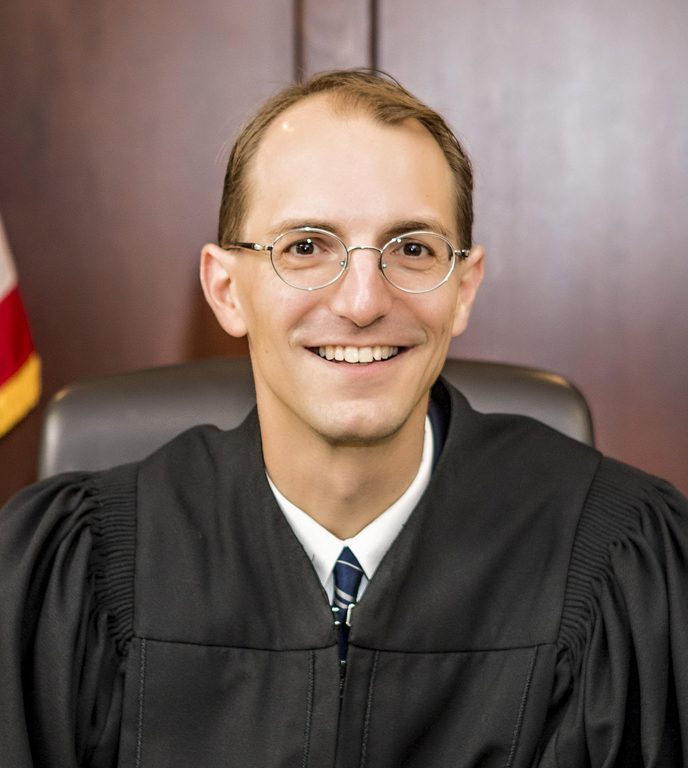
David Hejmanowski is running for Delaware County Common Pleas Court judge in the Probate/Juvenile Division in the Nov. 3 general election. He is running unopposed.
Asked why he is seeking the seat, Hejmanowski said in our candidate questionnaire: "I have served as Delaware County's Probate/Juvenile Court Judge since 2015 and was a magistrate and court administrator at that same court from 2003-2015. As the child of two teachers, I find our work with juveniles, families, and endangered adults to be incredibly rewarding. I hope to continue to use my 24 years of experience in all facets of the court to the benefit the participants in our cases."
Candidate information
Party affiliation: "Republican"
Education: In our questionnaire, Hejmanowski listed his education as "BA in Political Science, Hiram College, 1996" and "JD, Ohio State University Moritz College of Law, 1999."
Family: "Married with two adult children"
Family in politics or government: "No"
Experience and public service
Hejmanowski listed his work history in our questionnaire:
- "1999-2003 - Assistant Prosecuting Attorney, Delaware County Prosecutor's Office"
- "2003-2015 - Magistrate, Delaware County Probate/Juvenile Court"
- "2008-2015 - Court Administrator, Delaware County Probate/Juvenile Court"
- "2015-present - Judge, Delaware County Probate/Juvenile Court"
He also chairs the Ohio Judicial Conference, according to the Delaware Gazette. He has served on the Federal Advisory Committee on Juvenile Justice, the National Council of Juvenile and Family Court Judges and the Governor's Council on Juvenile Justice, according to the Delaware County Juvenile Court's website.
Asked about accomplishments, Hejmanowski said in the questionnaire: "Our court is viewed as a model court throughout the state. We have received numerous awards for our programing and efficiency. I have served as member of multiple state and national boards and am currently Chair of the Ohio Judicial Conference."
On the issues
Juvenile docket and detention: Asked how Delaware County's population growth has changed his juvenile docket and when a young person should be held in detention, Hejmanowski said: "Our docket has not only become significantly busier, but also has begun to see far more serious offenses than were previously common."
He continued: "Detention is always an issue of public safety - if there are no methods by which public safety can be protected with a child in the community, then detention becomes a necessity. Recidivism and successful completion rates permit us to measure the success of programs."
Guardianship oversight: Asked how the court screens and monitors guardians, he said: "In addition to state mandated guardian training and background checks, our court has implemented a Guardian Visitor program to visit each ward in guardianship case and to monitor the effectiveness of guardians."
He added: "I led the creation of our Guardianship Services Board to provide guardianship services to wards who do not have a person in their lives who is able to serve as guardian."
Remote hearings and accountability: Asked which pandemic-era remote hearings he has kept and how voters should judge his work, Hejmanowski said: "Generally, in-person hearings are more effective and productive. But remote hearings - particularly for case reviews and other non-evidentiary proceedings, can solve transportation issues and eliminate work consequences for parents."
He added: "Voters should look at the fact that we have a stable budget, are among the state's most efficient courts, and have one of the lowest recidivism rates in the country to judge the success of our work."
This nonpartisan judicial seat appears on the general election ballot.