For most of the 20th century, neighbors on opposite sides of Seldom Seen Road in Liberty Township couldn't call each other without paying a toll. A telephone company territory boundary, invisible but precise, ran down the center of the road from the Scioto River to the Olentangy, splitting the township into two separate calling areas.
A new history article from the Powell Liberty Historical Society, published Aug. 10, traces how that divide shaped friendships, commerce and suburban growth in what is now the Powell and Lewis Center area. The piece was written by Jose Prats, a Liberty Township resident.
Two companies, two worlds
South of the boundary, Ohio Bell Telephone Company connected residents to the Columbus local calling area. North of it, Northern Ohio Telephone Company, a small independent headquartered in Bellevue, Ohio, routed calls through Delaware. The two areas did not overlap.
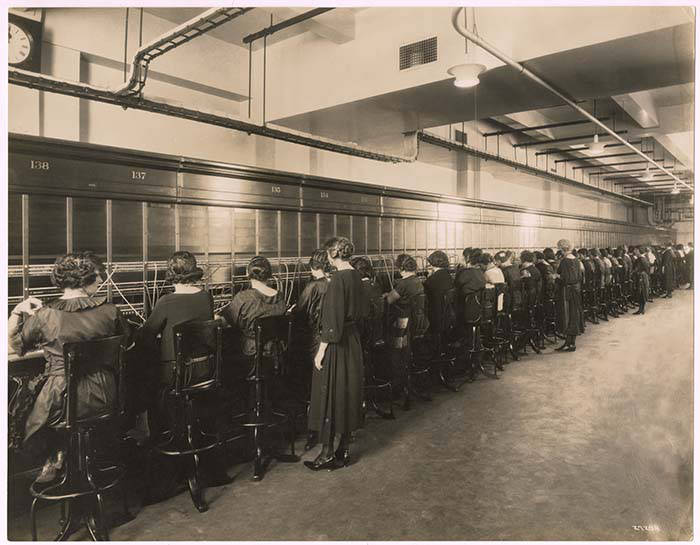
Calling across cost 22 cents for every three minutes, including a 10% federal tax Congress imposed in 1898 to fund the Spanish-American War. For perspective: in 1958, a loaf of bread cost 19 cents. Until the mid-1960s, residents couldn't even dial the number themselves. They dialed zero, waited for an operator, and a two-operator relay placed the call while a paper ticket tracked the charges.
The boundary's placement came down to which company strung its lines first and which proved the more persistent negotiator before the Public Utilities Commission when territory lines were finalized in the 1930s and '40s.
Commerce followed the phone book
The divide shaped more than friendships. Ohio Bell customers received a Columbus phone book each year; Northern Ohio customers got the Delaware directory. Whichever book listed your number determined who called you for business, whether you were a plumber, a dentist or an auto parts dealer.
Five years without a phone
The boundary's most vivid local consequence played out in the Carriage Road neighborhood off Olentangy River Road. Platted in the early 1960s as the Westchester Subdivision, the development straddled the territory line, with roughly half its homes in each company's zone.
When building picked up in the 1980s, Northern Ohio Telephone refused to bury its lines underground as the subdivision's deed restrictions required. Some homes in the northwestern section went up to five years without telephone service.
Jim Rush, one of the original residents on Wren Lane, and Bill Kramer persistently demanded the company provide service. When Northern Ohio announced it was ready to install Rush's phone using above-ground poles, Rush asked whether the company knew utilities were required to be underground per courthouse filings. The company declared it had no intention of burying the line.
The standoff ended only when Northern Ohio agreed to furnish cable and drop it into a trench if Olentangy River Realty dug it, requiring 4,000 to 5,000 feet of trenching.
Maggie Webb, a historian and Carriage Road homeowner since 1981, recalled in the 2010 book "8060 Olentangy River Road Delaware Ohio 43015" by Steven Conliff that "making phone calls in those days could elicit tears of exasperation."
The boundary disappears
Relief came in stages. In 1961, Northern Ohio opened a new Rathbone exchange engineered to connect to both the Columbus and Delaware calling areas, pushing the effective toll line about 3½ miles north to Hyatts Road. That free-calling bridge enabled the housing subdivisions that define Powell, Jerome and Lewis Center.
By 1992, after Ohio Bell and GTE (Northern Ohio's successor) both offered Extended Local Calling Plans, the toll boundary vanished entirely. Delaware subscribers could call Powell for free, and vice versa.
The old divide hasn't completely disappeared. A 2026 photo in the article shows Seldom Seen Road with a Verizon pole on one side and an American Electric Power pole on the other, each carrying its respective company's cables. Analog copper-wire telephone service along Liberty Township's roads is scheduled to end in 2029.
Connect with the historical society
The Powell Liberty Historical Society is located at 103 E. Olentangy St. in Powell. Visitors can stop by the Martin-Perry House from 10 a.m. to 3 p.m. on Wednesdays or call (614) 848-6210.